
Advanced Infrared Technology. Professional Building Evaluations. Informed Property Decisions.
Not every building deficiency is visible during a conventional commercial property inspection. Moisture intrusion, insulation deficiencies, air leakage, and abnormal equipment temperatures may develop without obvious signs of damage.
At Southeast Building Consultants, LLC, we provide commercial thermal imaging and infrared inspection services to help property owners, investors, facility managers, and building operators identify unusual thermal patterns that may indicate conditions requiring further evaluation.
Our infrared services are available as stand-alone inspections or as optional add-ons to Commercial Property Condition Assessments (PCAs), Commercial Building Inspections, and Facility Condition Assessments (FCAs).
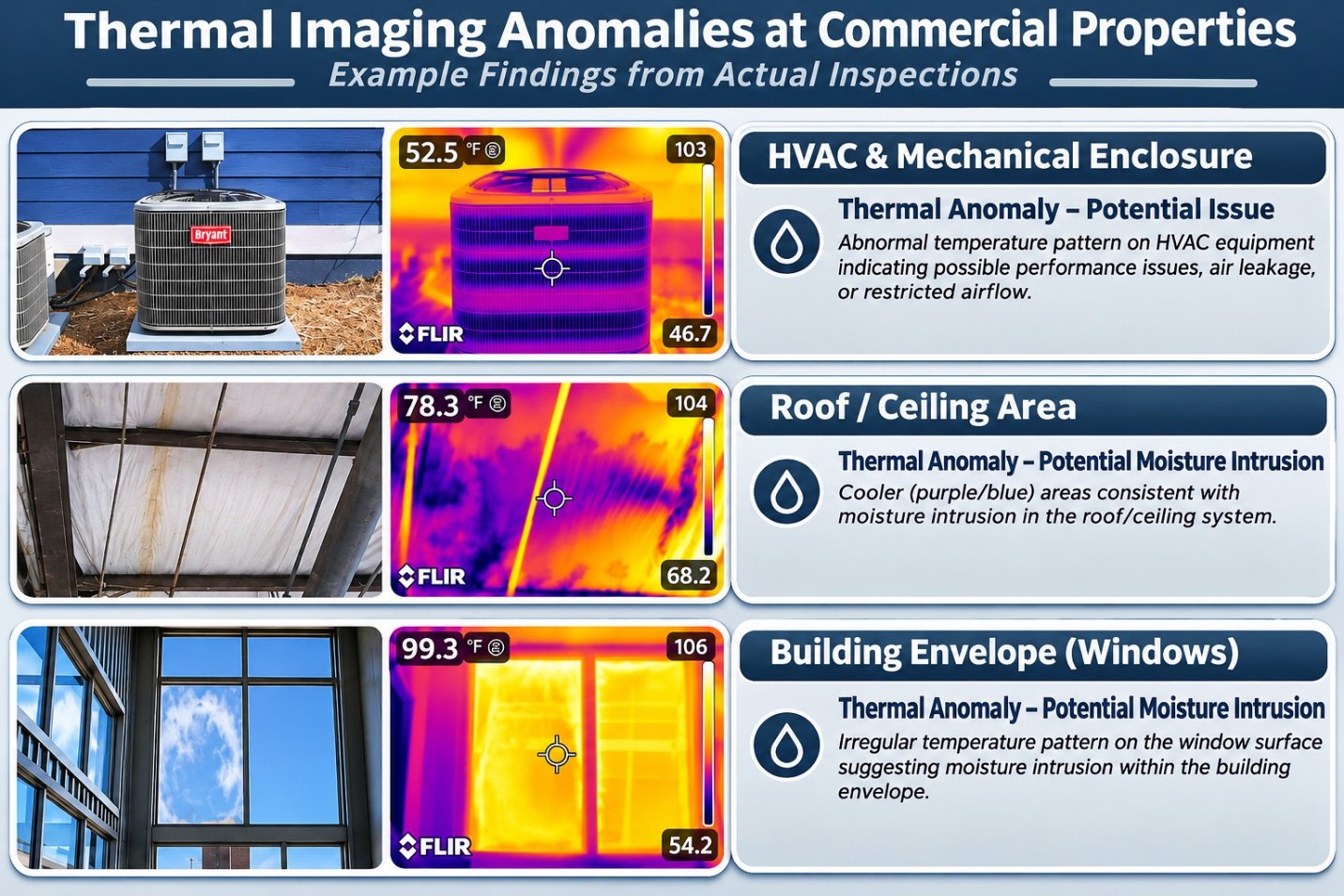
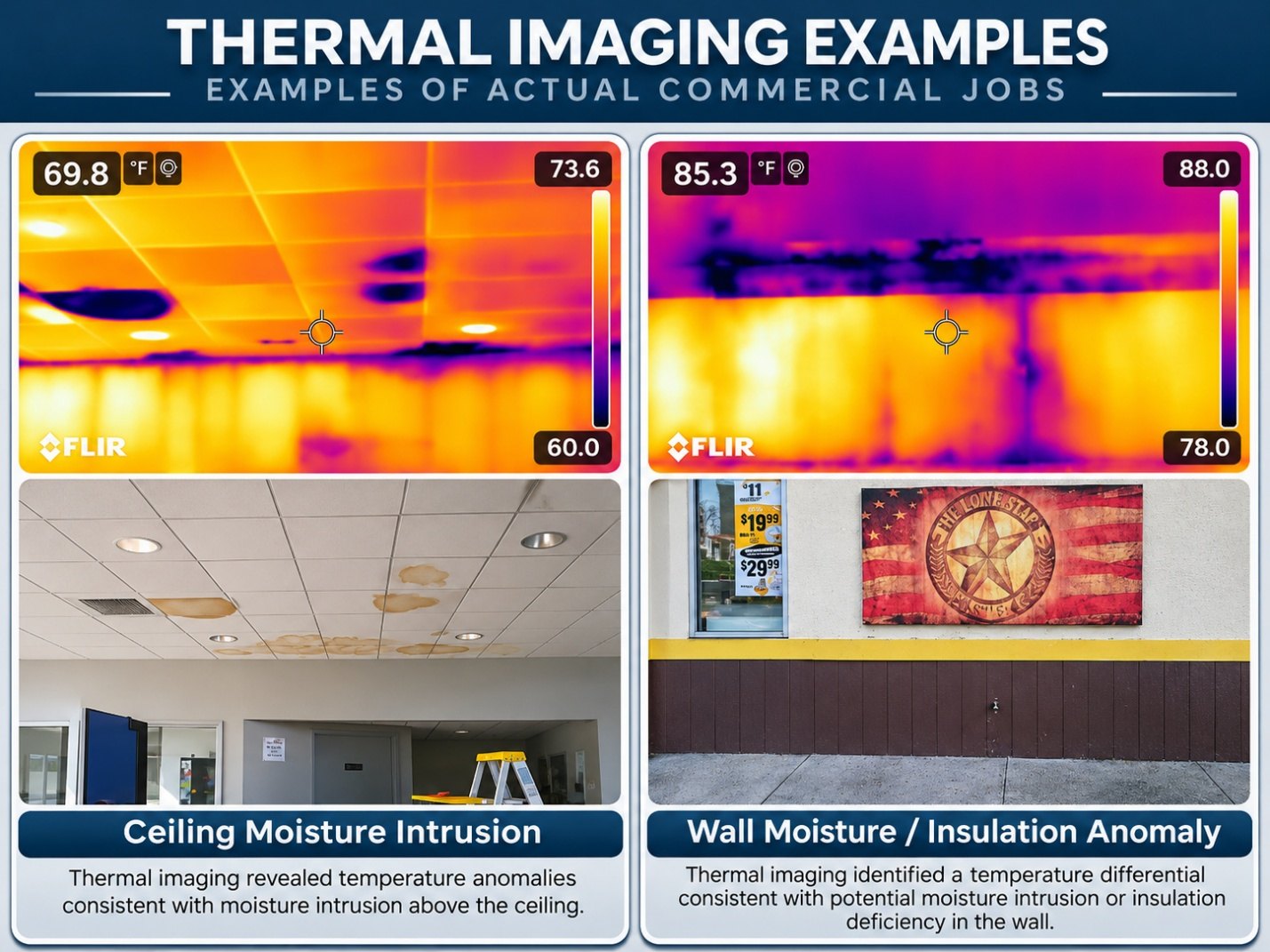
What Is Commercial Thermal Imaging?
Commercial thermal imaging, also called infrared thermography, is a non-invasive inspection method that uses specialized infrared cameras to detect and display apparent surface temperature differences.
Unlike conventional cameras, which capture visible light, infrared cameras detect emitted infrared energy and convert it into thermal images.
These images can help inspectors recognize unusual temperature patterns associated with suspected moisture intrusion, missing insulation, air leakage, or abnormal equipment operating temperatures.
Infrared cameras do not see through walls or directly detect moisture. Thermal findings must be interpreted in relation to the building's construction, environmental conditions, and other available information.
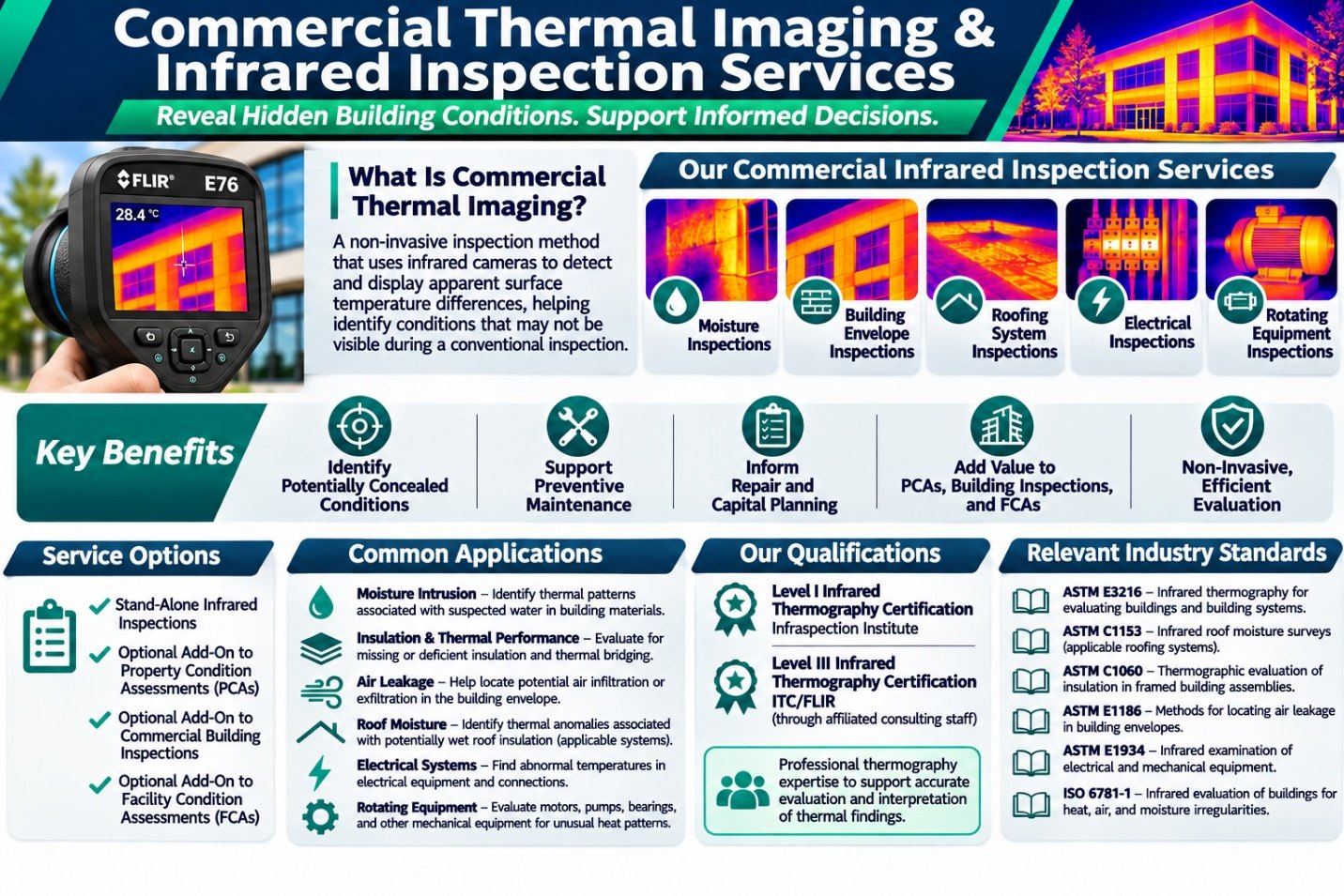
Our Commercial Infrared Inspection Services
Infrared Moisture Inspections
Moisture intrusion can damage building materials, contribute to deterioration, and create expensive maintenance concerns.
Infrared imaging may help identify temperature patterns associated with suspected moisture in walls, ceilings, and other accessible building components.
Thermal findings can help direct additional moisture testing toward areas of concern.
Building Envelope Infrared Inspections
A building's exterior envelope plays an important role in protecting interior spaces from weather and controlling heat transfer.
Infrared thermography can help identify thermal irregularities associated with missing insulation, thermal bridging, possible air leakage, and other building envelope concerns.
Commercial Roof Infrared Inspections
Certain commercial roofing systems can be evaluated using infrared thermography to locate thermal patterns associated with potentially wet roof insulation.
When roof construction and environmental conditions are suitable, infrared roof surveys may help identify areas requiring additional moisture verification or roof evaluation.
Electrical Infrared Inspections
Infrared thermography can identify abnormal temperature patterns in certain energized electrical components.
Specialized electrical infrared inspections may help identify conditions requiring further evaluation, maintenance, or testing.
These services require appropriate personnel qualifications, operating conditions, and electrical safety procedures.
Rotating Equipment Infrared Inspections
Thermal imaging can be used to evaluate temperature patterns associated with operating motors, pumps, bearings, and other rotating equipment.
Abnormal thermal patterns may indicate conditions requiring additional maintenance or diagnostic evaluation.
Benefits of Commercial Thermal Imaging
Non-Invasive Evaluation
Infrared imaging allows apparent surface temperature patterns to be observed without removing building finishes or disturbing components.
Identification of Potentially Concealed Conditions
Thermal anomalies may help identify locations requiring additional investigation.
Improved Maintenance Planning
Infrared findings can help property owners and facility managers prioritize further evaluations and maintenance activities.
Support for Commercial Property Evaluations
Thermography can provide supplementary information during property acquisitions, building inspections, and facility assessments.
Better Documentation
Thermal images and corresponding visible-light photographs can help communicate observed conditions and locations of concern.
Certified Infrared Thermography Professionals
Southeast Building Consultants, LLC offers infrared inspection services supported by professional thermography training and specialized technical expertise.
Our qualifications include:
- Level I Infrared Thermography Certification — Infraspection Institute
- Level III Infrared Thermography Certification — ITC/FLIR, through affiliated consulting staff
Our Level I qualification and access to affiliated Level III consulting expertise support the evaluation and interpretation of thermal findings within the appropriate inspection scope.
Specialized inspections are performed or supported by personnel with qualifications appropriate to the work being conducted.
Commercial Thermal Imaging Standards
Depending on the inspection application, relevant technical standards and guidelines may include:
- ASTM E3216 — Infrared thermography for evaluating buildings, building systems, and equipment.
- ASTM C1153 — Infrared roof moisture surveys for applicable roofing systems.
- ASTM C1060 — Thermographic evaluation of insulation in framed building assemblies.
- ASTM E1186 — Methods for locating air leakage in building envelopes.
- ASTM E1934 — Infrared examination of electrical and mechanical equipment.
- ISO 6781-1 — Infrared methods for detecting heat, air, and moisture irregularities in buildings.
- ISO 18434-1 — Thermography for machinery condition monitoring and diagnostics.
- Infraspection Standards - Infrared Thermography Standards & ASNT Certification
The applicable procedures and standards depend on the property's characteristics, inspection objectives, and agreed scope of services.
How Does a Commercial Thermal Imaging Inspection Work?
Step 1 — Define the Scope
We discuss the property, inspection objectives, building systems, and areas of concern.
Step 2 — Review Inspection Conditions
We consider relevant environmental conditions, equipment operation, accessibility, and other factors that may affect thermal imaging results.
Step 3 — Perform the Infrared Survey
Accessible building surfaces or equipment are evaluated using infrared imaging technology.
Step 4 — Document Thermal Findings
Identified anomalies are documented and evaluated alongside available visual observations and supporting information.
Step 5 — Prepare the Inspection Report
The report describes relevant observations, thermal images, inspection limitations, and recommendations for further evaluation when appropriate.
Thermal Imaging as an Add-On or Stand-Alone Service
Infrared thermography can complement a commercial building evaluation by providing additional information about selected systems and components.
Southeast Building Consultants offers thermal imaging as an optional service with:
- Commercial Property Condition Assessments (PCAs)
- Commercial Building Inspections
- Facility Condition Assessments (FCAs)
We also offer stand-alone infrared inspections for specific building concerns or equipment systems.
Commercial Properties We Serve
Our infrared services may be suitable for:
- Office buildings and business parks
- Retail centers and shopping facilities
- Warehouses and industrial properties
- Medical office buildings
- Educational facilities
- Hotels and hospitality properties
- Multifamily residential buildings
- Government and institutional facilities
Important Limitations of Infrared Thermography
Infrared cameras measure apparent surface temperature patterns. They do not see through walls, directly identify water or mold, or independently establish the cause of every thermal anomaly.
Weather, solar exposure, building materials, reflective surfaces, equipment operating conditions, and other factors may affect results.
Additional testing or evaluation may be necessary to determine the cause and significance of observed anomalies.
Frequently Asked Questions
Can thermal imaging detect hidden building problems?
Thermal imaging may identify temperature differences associated with concealed or difficult-to-observe conditions. However, additional evaluation is often necessary to determine the underlying cause.
Is infrared thermography included in every commercial inspection?
No. Southeast Building Consultants offers thermal imaging as an optional add-on or as a stand-alone service. The specific inspection scope is established before the project begins.
Does thermal imaging damage building materials?
No. Infrared imaging is non-invasive and does not require removing building finishes. Additional testing may be recommended when thermal findings require verification.
Can thermal imaging detect moisture?
Infrared cameras do not directly detect water. They identify thermal patterns that may be associated with moisture under suitable conditions.
How much does a commercial thermal imaging inspection cost?
Pricing depends on the property, systems evaluated, accessibility, inspection objectives, and reporting requirements.
Whether you need an infrared moisture investigation, building envelope evaluation, roof survey, electrical inspection, or rotating equipment assessment, Southeast Building Consultants can help determine an appropriate inspection scope.