
Thermal Imaging for Motors, Pumps, Bearings, and Mechanical Equipment Condition Monitoring.
Rotating equipment plays an important role in commercial buildings, industrial facilities, and mechanical systems.
Motors, pumps, fans, bearings, and other rotating components operate under mechanical and electrical loads that generate heat.
When equipment experiences abnormal friction, lubrication problems, excessive loading, or other operating concerns, unusual temperature patterns may develop.
At Southeast Building Consultants, LLC, we offer infrared inspections of rotating equipment to help identify thermal anomalies that may indicate conditions requiring additional maintenance or diagnostic evaluation.
Our services are available as stand-alone inspections or as optional additions to Property Condition Assessments (PCAs), Commercial Building Inspections, and Facility Condition Assessments (FCAs).
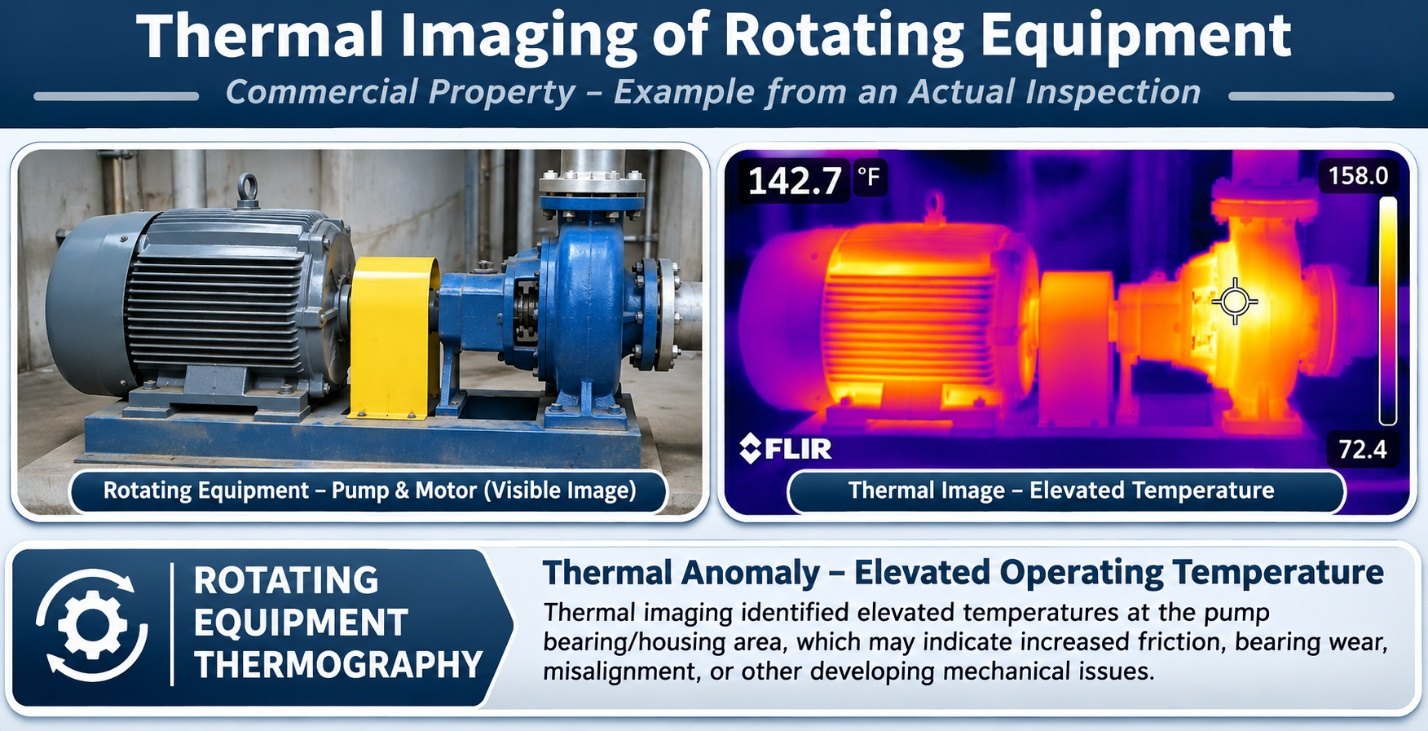
What Is a Rotating Equipment Infrared Inspection?
A rotating equipment infrared inspection uses thermal imaging technology to evaluate apparent surface temperatures and temperature differences in operating mechanical equipment.
Infrared cameras allow thermographers to observe temperature patterns without directly contacting moving components.
These thermal patterns may provide useful information about equipment operating conditions and help identify areas requiring additional evaluation.
Thermography is commonly used as part of a broader equipment condition monitoring or preventive maintenance program.
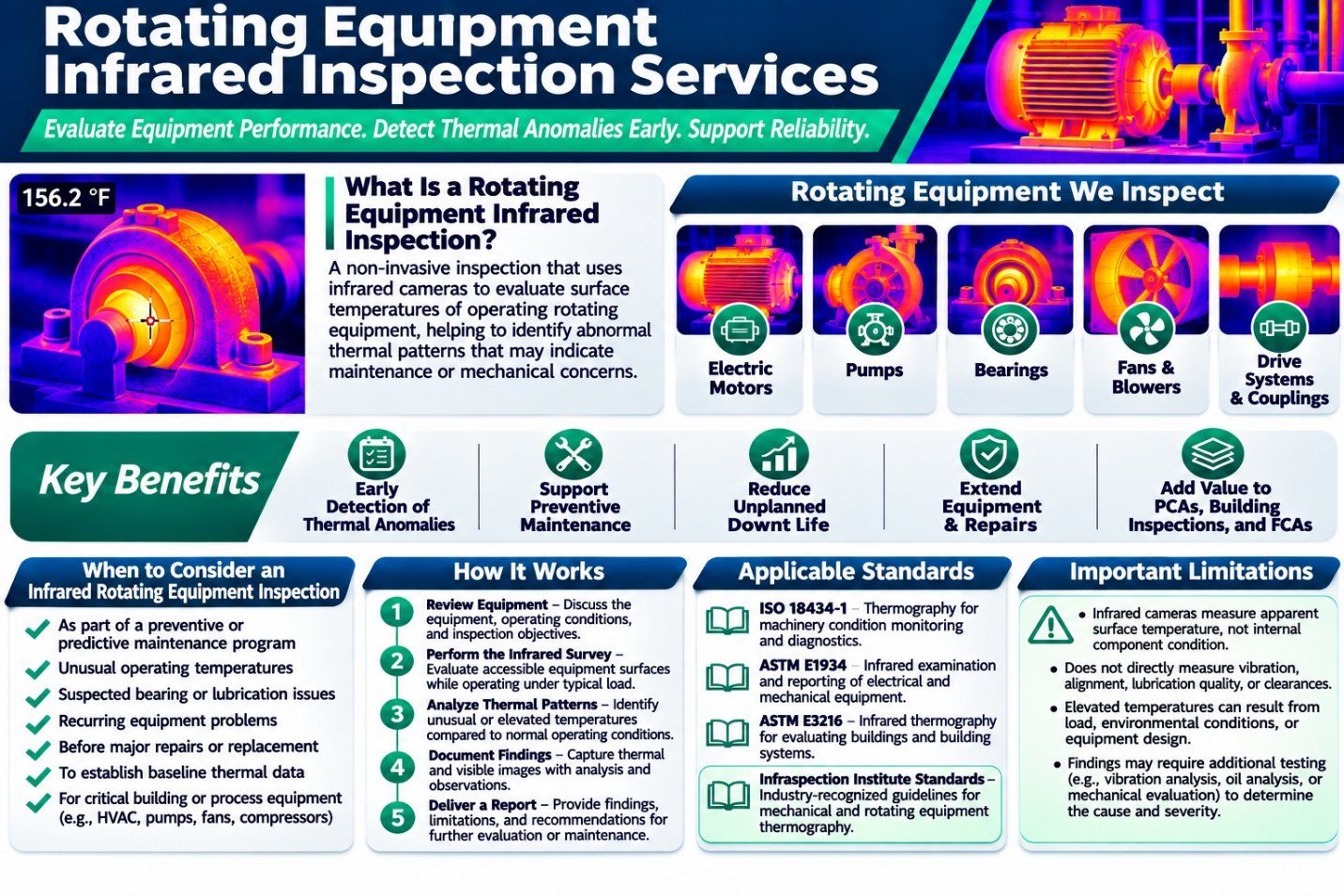
What Types of Rotating Equipment Can Be Inspected?
Depending on equipment accessibility, operating conditions, and the agreed inspection scope, infrared thermography may be used to evaluate:
Electric Motors
Thermal imaging may identify abnormal temperature patterns involving motor housings, accessible electrical connections, and other components.
Pumps
Infrared inspections may help evaluate unusual temperatures associated with pump housings, bearings, and related accessible components.
Bearings
Excessive bearing temperatures may be associated with friction, lubrication deficiencies, loading conditions, or other mechanical concerns.
Thermal imaging can help identify temperature differences that warrant additional investigation.
Fans and Blowers
Commercial ventilation and industrial air-moving equipment may be evaluated for unusual thermal patterns associated with motors, bearings, and accessible mechanical components.
Mechanical Drive Systems
Selected drive assemblies, couplings, and related equipment may be evaluated when safe access and appropriate operating conditions are available.
Other Mechanical Equipment
Additional rotating machinery may be included based on the facility's equipment and inspection objectives.
What Can Infrared Thermography Reveal?
Abnormal Bearing Temperatures
Elevated bearing temperatures may indicate operating conditions that require additional maintenance or testing.
Possible Lubrication Concerns
Insufficient or improper lubrication can contribute to increased friction and heat generation.
Thermal imaging may identify elevated temperatures associated with these conditions, but it cannot independently diagnose lubrication problems.
Unusual Motor Temperatures
Abnormal motor surface temperatures may be associated with electrical loading, cooling deficiencies, operating conditions, or internal equipment concerns.
Potential Mechanical Friction
Excessive friction may produce unusual heat patterns in certain accessible components.
Cooling and Ventilation Concerns
Restricted airflow or inadequate equipment cooling may contribute to abnormal operating temperatures.
Infrared findings should be evaluated alongside equipment operating information and other diagnostic methods.
Why Are Rotating Equipment Infrared Inspections Important?
Mechanical equipment failures can interrupt building operations and result in expensive repairs or unplanned downtime.
Infrared thermography may support preventive and predictive maintenance programs by identifying unusual operating temperatures.
Benefits may include:
Early Recognition of Thermal Anomalies
Identify abnormal temperature patterns that may indicate equipment requiring further investigation.
Support for Preventive Maintenance
Provide information to help maintenance teams evaluate equipment condition and schedule additional testing.
Reduced Risk of Unexpected Downtime
Timely investigation of thermal anomalies may help reduce the likelihood of certain equipment failures.
Improved Equipment Documentation
Thermal images can establish records for future comparison when collected under comparable operating conditions.
Better Maintenance Prioritization
Findings may help maintenance personnel determine which equipment requires closer evaluation.
How Does a Rotating Equipment Infrared Inspection Work?
Step 1 — Identify Equipment and Inspection Objectives
We review the equipment to be evaluated, operating conditions, maintenance concerns, and inspection objectives.
Step 2 — Review Equipment Operation and Safety
Equipment accessibility, operating loads, moving machinery hazards, and site-specific safety requirements are considered.
Step 3 — Perform Infrared Imaging
Accessible equipment surfaces are evaluated for unusual temperature patterns while operating under appropriate conditions.
Step 4 — Compare Thermal Observations
When suitable, temperatures and patterns may be compared with similar equipment, manufacturer information, previous inspection records, or established operating conditions.
Step 5 — Document Findings
Relevant anomalies are documented using infrared images, visible-light photographs, and available supporting information.
Step 6 — Prepare the Report
The report describes observed thermal conditions, inspection limitations, and recommendations for additional maintenance or diagnostic evaluation when appropriate.
Infrared Inspection Standards for Rotating Equipment
Relevant technical standards and guidance may include:
ISO 18434-1 Provides procedures for thermography used in machinery condition monitoring and diagnostics.
ASTM E1934 Addresses infrared examination and reporting involving electrical and mechanical equipment.
ASTM E3216 Provides broader guidance for infrared evaluation of building systems and equipment.
ISO 18436-7 Addresses qualification and assessment of personnel performing machinery thermography.
Infraspection Institute Standard for Infrared Inspection of Electrical Systems and Rotating Equipment
The standards applicable to a specific project depend on the inspection scope, equipment characteristics, and personnel requirements.
Certified Infrared Thermography Professionals
Southeast Building Consultants, LLC provides infrared inspection services supported by professional training and specialized consulting expertise.
Our qualifications include:
- Level I Infrared Thermography Certification — Infraspection Institute
- Level III Infrared Thermography Certification — ITC/FLIR, through affiliated consulting staff
The personnel assigned to specialized machinery inspections depend on the equipment, safety requirements, and agreed scope.
Important Limitations of Rotating Equipment Thermography
Infrared thermography identifies apparent surface temperature patterns. It does not directly measure internal bearing condition, vibration, mechanical alignment, or lubrication quality.
Elevated temperatures may result from normal operating loads, environmental conditions, equipment design, or other factors.
Thermal findings may require additional evaluation using vibration analysis, lubrication analysis, electrical testing, or other diagnostic methods.
Infrared inspections do not replace manufacturer maintenance requirements or established equipment safety procedures.
Frequently Asked Questions
Can infrared imaging detect failing bearings?
Infrared thermography may identify abnormal bearing temperatures associated with developing mechanical concerns. However, it cannot independently determine bearing condition or predict the exact time of failure.
Can thermal imaging detect motor problems?
Infrared imaging may identify unusual motor temperature patterns that warrant additional investigation. Other diagnostic methods may be needed to determine the cause.
Does equipment need to be operating during an infrared inspection?
Typically, yes. Representative operating conditions are often important for meaningful rotating equipment thermal evaluations.
Can thermal imaging replace vibration analysis?
No. Infrared thermography and vibration analysis provide different types of information and are often complementary condition monitoring methods.
How often should rotating equipment receive infrared inspections?
Inspection frequency depends on equipment criticality, operating conditions, maintenance history, manufacturer recommendations, and the facility's maintenance program.
Can rotating equipment inspections be performed during a Facility Condition Assessment?
Yes, when the specialized equipment inspection is included in the agreed scope and appropriate operating and safety conditions are available.
Southeast Building Consultants, LLC provides infrared inspections of commercial and industrial rotating equipment to help identify unusual operating temperatures and support informed maintenance decisions.
Whether evaluating motors, pumps, bearings, fans, or other mechanical systems, infrared thermography can provide useful information about equipment conditions.