
Southeast Building Consultants, LLC, is highly trusted with over 22 years’ experience and thousands of commercial inspections in several states including Georgia, Alabama, Tennessee and North Carolina.
At Southeast Building Consultants, LLC, we offer professional Facility Condition Assessments (FCAs) for commercial and industrial properties throughout Georgia, Alabama, Tennessee, North Carolina, and surrounding Southeastern states. Our services are tailored to meet the exact client's needs.
We help you understand your building's condition, prioritize repairs, and plan for future capital expenses with a professional Facility Condition Assessment (FCA).
Commercial buildings require ongoing maintenance, repairs, and eventual system or component replacements. As properties age, roofing materials deteriorate, mechanical equipment wears down, and other components or systems will need attention. A Facility Condition Assessment (FCA) helps property owners, facility managers, and organizations understand existing building conditions and plan future improvements.
At Southeast Building Consultants, LLC, we provide commercial facility assessment services designed to document observable deficiencies, identify maintenance priorities, and support informed property management and capital planning decisions.
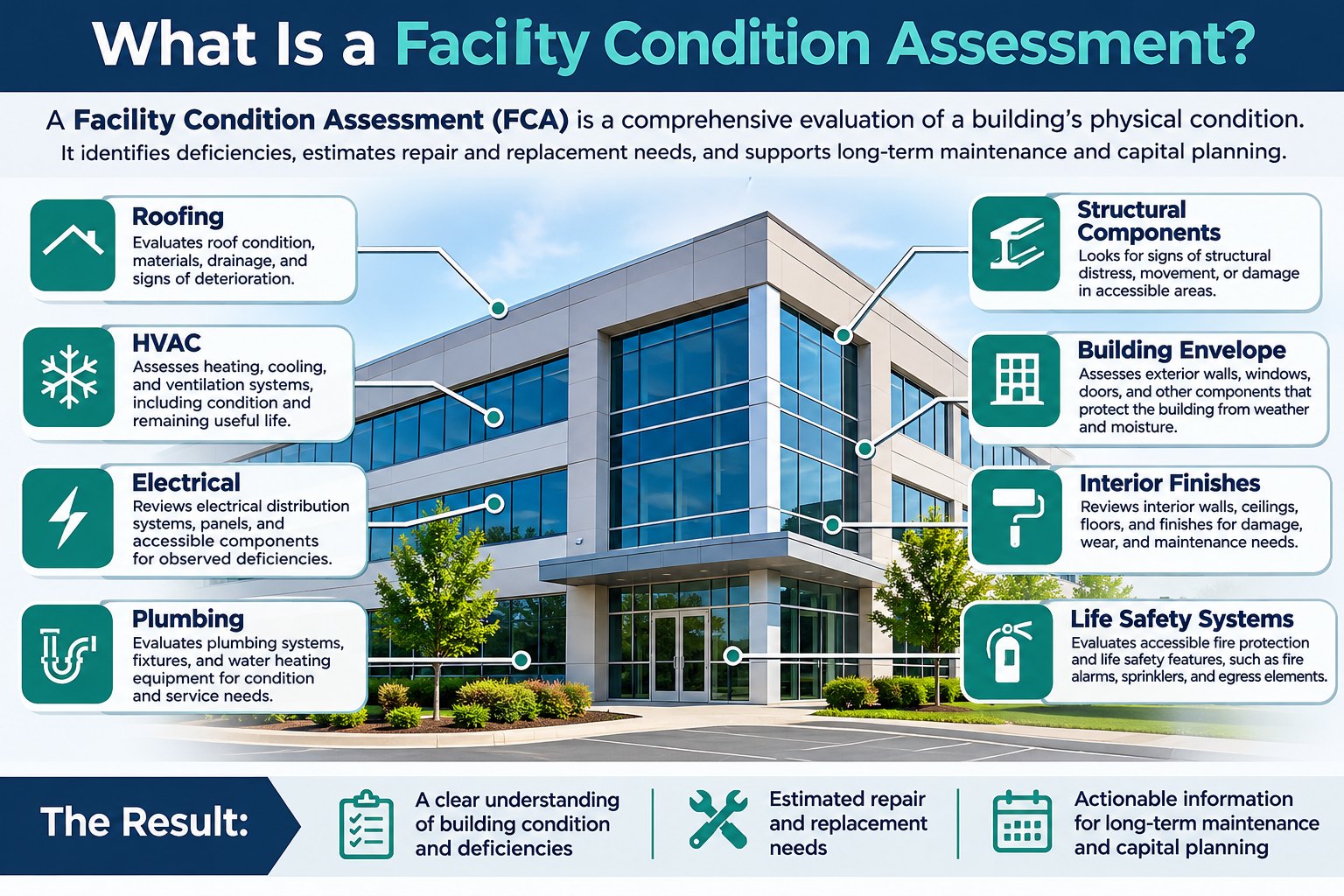
What Is a Facility Condition Assessment?
A Facility Condition Assessment is a systematic evaluation of a building's physical condition, including its major systems and components. It identifies observable deficiencies and helps determine which systems may need maintenance, repair, replacement, or further evaluation.
Unlike a routine maintenance walkthrough, an FCA takes a broader look at a facility's current condition and anticipated future needs. Depending on the agreed scope of work, findings can support multi-year repair budgets and capital renewal planning.
An FCA helps answer important questions:
- What is the current condition of our building?
- Which systems are aging or showing deterioration?
- What repairs or replacements should we prioritize?
- What major expenses may be expected in the coming years?
- How can we make better maintenance and capital budgeting decisions?
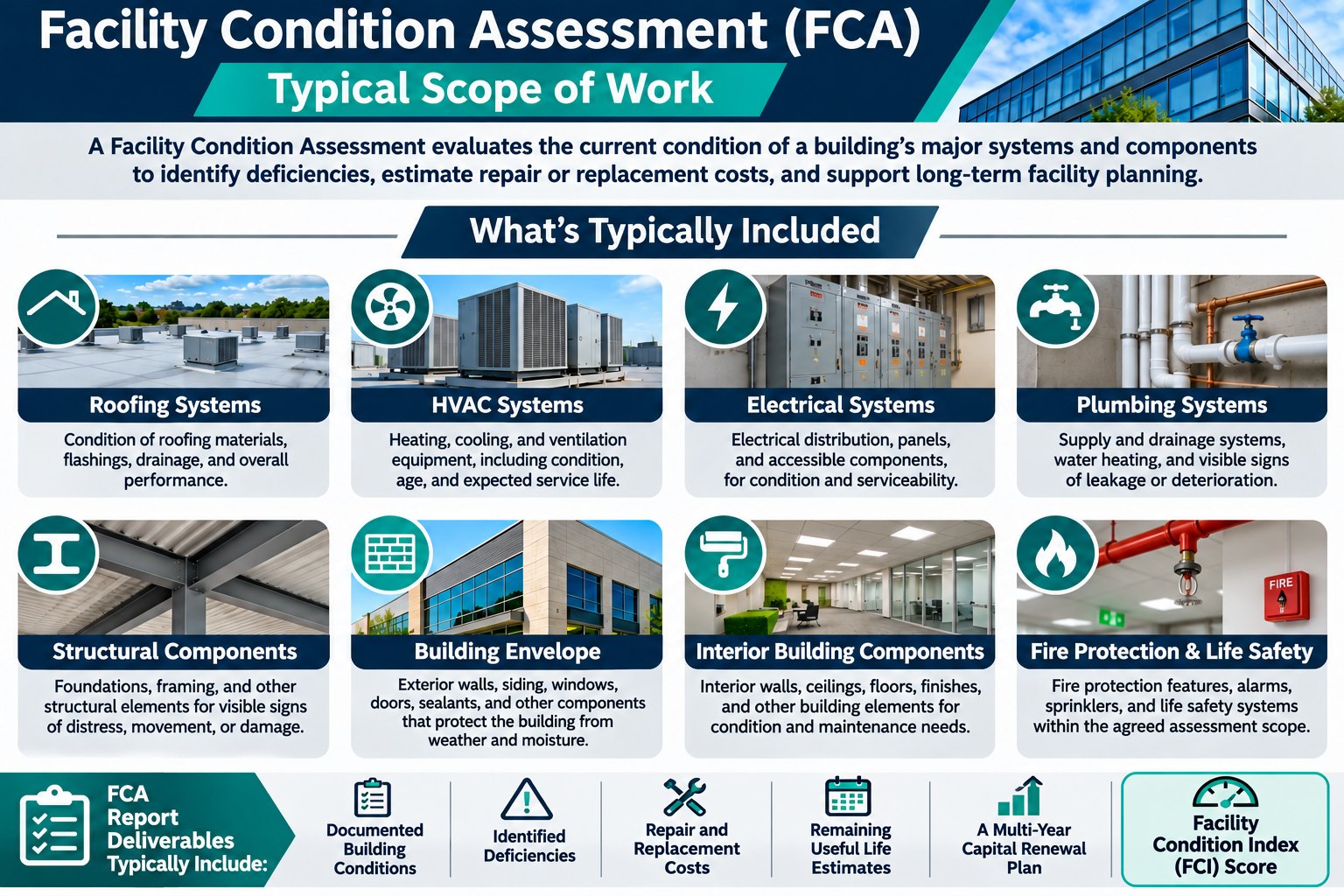
What Does a Facility Condition Assessment Include?
Most FCAs involve visual observations of readily accessible building systems and components. The exact assessment scope depends on the property's size, age, use, accessibility, and the client's planning objectives.
Roofing Systems
Accessible roofing materials, drainage components, and visible indications of wear, damage, or potential water intrusion.
HVAC Systems
Accessible heating, cooling, and ventilation equipment, including apparent condition, age, maintenance concerns, and potential replacement needs.
Electrical Systems
Visible conditions of accessible electrical panels, distribution equipment, and related components that may warrant maintenance or further evaluation.
Plumbing Systems
Accessible supply and drainage components, plumbing fixtures, water heating equipment, and visible signs of leaks or deterioration.
Structural Components
Accessible foundations, framing, and other structural elements for observable signs of distress, movement, damage, or deterioration.
Building Exterior & Envelope
Exterior walls, windows, doors, cladding, sealants, and accessible features that help protect the building from weather and moisture.
Interior Components
Accessible interior walls, ceilings, flooring, finishes, and other components for visible deficiencies and maintenance concerns.
Fire Protection & Life Safety
General observations of accessible life safety features within the agreed scope. Specialized testing or code compliance reviews may require additional specialists.
Why Is a Facility Condition Assessment Important?
Many organizations know their buildings need work. The challenge is deciding what needs deserve attention first, how much it may cost, and how to plan for those expenses. An FCA provides organized information to help move from reactive repairs toward more deliberate facility management such as preventative maintenance, routine replacement cycles, and predictive maintenance.
- Clear visibility into facility needs: Document existing deficiencies, aging equipment, and maintenance priorities.
- Better capital planning: Anticipate repair and replacement needs over 5, 10, or even 20 years when a long-term forecast is included in the scope.
- Support for funding decisions: Communicate documented needs and cost estimates to leadership, boards, and stakeholders.
- Reduced risk of unexpected expenses: Identify visible signs of deterioration, wear, or issues that may warrant timely action before costly failures occur.
What is typically included in a Facility Condition Assessment?
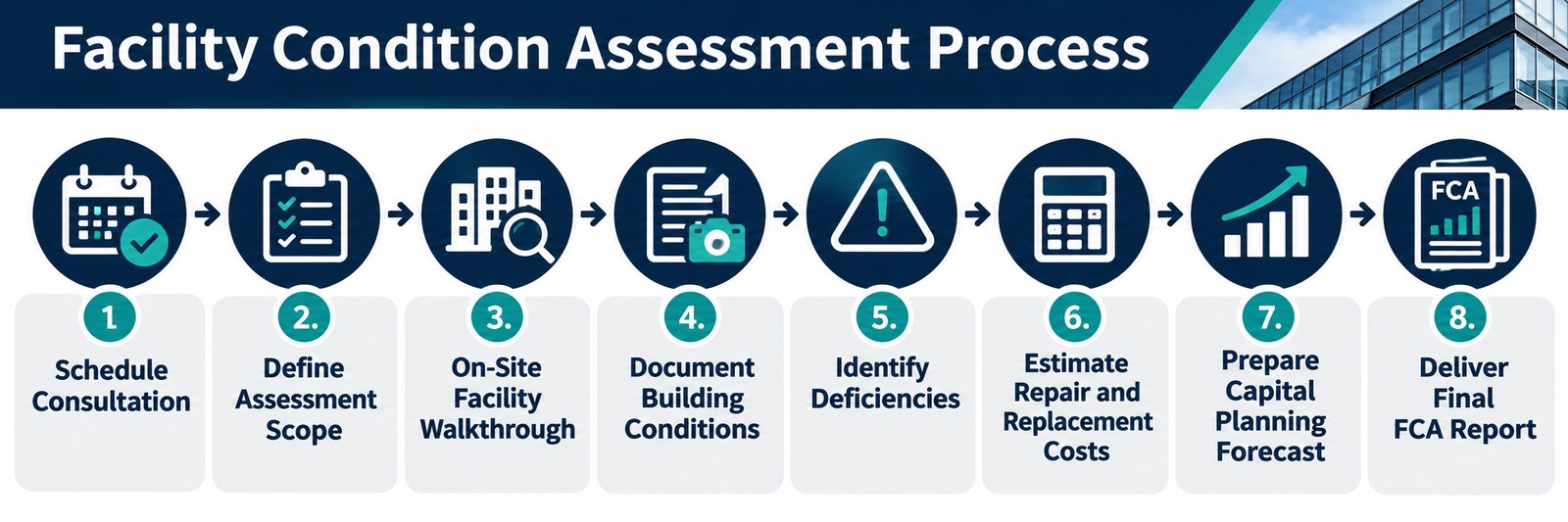
An FCA is more than a routine inspection. It combines on-site evaluation, building system information, and planning analysis. While each project is different, the process commonly includes:
- On-site evaluation: Assessors visit the property and visually review accessible building systems and components.
- Data collection: Available information is gathered about condition, apparent age, maintenance history, and estimated remaining useful life.
- Deficiency identification: Observed issues that may require maintenance, repair, replacement, or further evaluation are documented.
- Cost estimating: Opinions of probable costs may be developed for identified improvements.
- Capital planning: Findings may be organized into a multi-year capital renewal forecast.
Specialized engineering evaluations may be recommended when specific systems require more detailed investigation.
Facility Condition Assessments and Capital Planning
Major building systems have finite service lives. Roofing, HVAC equipment, plumbing infrastructure, and other components eventually require significant repairs or replacement. An FCA helps organizations anticipate these needs and develop more realistic budgets.
Depending on the agreed scope, a capital renewal plan may identify recommended projects, estimated costs, expected timing, and near-term versus long-term priorities. Some organizations use FCA findings to plan capital expenses over 5, 10, or 20 years.
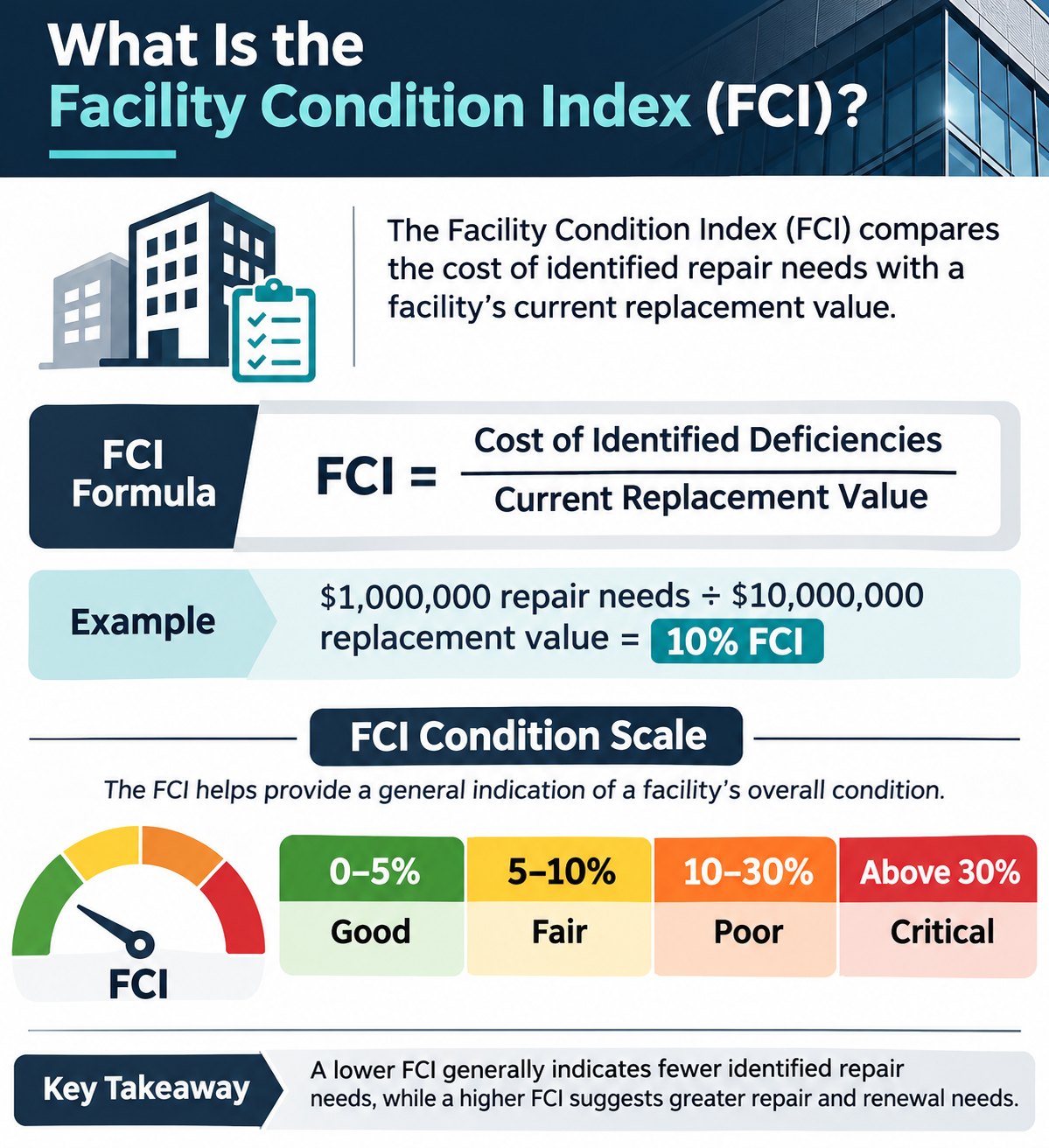
Understanding the Facility Condition Index (FCI)
The Facility Condition Index (FCI) is a commonly used measure for comparing the estimated cost of identified deficiencies with a facility's current replacement value.
FCI = Cost of Identified Deficiencies ÷ Current Replacement Value
For example, if identified deficiencies total $1 million and a facility's current replacement value is $10 million, its FCI is 10%.
A lower FCI generally indicates fewer identified repair and renewal needs relative to replacement value. A higher FCI indicates greater needs. Commonly referenced planning ranges are 0–5% (good), 5–10% (fair), 10–30% (poor), and above 30% (critical), although thresholds vary by methodology and organization.
FCI can help organizations compare buildings within a portfolio and prioritize investments. FCI calculations are not included in every FCA and should be specified in the assessment scope.
Who Can Benefit from a Facility Condition Assessment?
FCAs support commercial property owners, facility managers, finance leaders, executives, and organizations responsible for one building or an entire portfolio.
Commercial Properties
Office buildings, business parks, retail centers, mixed-use developments, and hospitality properties.
Industrial Facilities
Warehouses, distribution centers, and other industrial buildings.
Institutional Facilities
Schools, campuses, healthcare facilities, and government or municipal buildings.
Multi-Building Portfolios
Organizations seeking consistent condition data and capital priorities across multiple facilities.
Facility Condition Assessment Services Throughout Georgia, North Carolina, Tennessee and Alabama
Southeast Building Consultants, LLC provides commercial building assessment services designed to help clients better understand their facilities. Our approach emphasizes methodical visual observations, clear documentation, and practical findings that support informed maintenance and capital planning decisions.
Whether you are evaluating an individual property or planning improvements across multiple facilities, we can discuss your objectives and the assessment scope appropriate for your buildings.
What standards or frameworks are used to define a Facility Condition Assessment (FCA) scope of work?
We primarily customize your assessment's scope of work based on your industry and property type. The most widely used frameworks include ASTM E2018 for commercial properties, NCSI for K-12 public schools, APPA for higher education, and ISO 41001 for global enterprise portfolios.
To ensure clean data, all of our assessments categorize building components using the ASTM E1557 (UNIFORMAT II) framework and calculate costs using localized RSMeans data.
🏢 Commercial & Real Estate Standards
What is the ASTM E2018 standard, and when is it used?
- Best For: Commercial buildings, real estate investors, and lenders.
- The Blueprint: ASTM E2018 is the gold standard for commercial real estate due diligence. It defines exactly what a consultant must look at during a baseline building walk-through.
- The Goal: It identifies immediate physical deficiencies and calculates a Facility Condition Index (FCI) so buyers or lenders understand short-term financial risks before a transaction closes.
- Official Resource: ASTM International E2018 Standard Guide
What are ISO 41001 and ISO 41011 standards?
- Best For: Corporate headquarters, multinational enterprise portfolios, and industrial facilities.
- The Blueprint: Rather than detailing how to inspect a specific pipe or roof, ISO 41001 and ISO 41011 establish global rules for strategic asset management.
- The Goal: They ensure your facility assessment seamlessly integrates into a broader corporate risk management, compliance, and long-term lifecycle cost plan.
- Official Resource: ISO 41001:2018 Standard Page
🏫 Public Infrastructure & Institutional Frameworks
What is the NCSI framework for K-12 schools?
- Best For: Public school districts, municipal boards, and educational infrastructure planning.
- The Blueprint: Created specifically for public schools, the NCSI (National Center on School Infrastructure) Manual and Workbook shifts the focus from commercial real estate risk to long-term community planning.
- The Goal: It gives school districts open-source tools to accurately track the remaining useful life of educational assets, structure uniform Requests for Proposals (RFPs) for fair consultant bidding, and prioritize public funding allocations.
- Official Resource: NCSI Resources Page / National Council on School Facilities Tools
What are APPA standards?
- Best For: Universities, colleges, and large institutional campuses.
- The Blueprint: Developed by APPA (Leadership in Educational Facilities), this framework pairs physical system inspections with space adequacy and educational functionality.
- The Goal: It helps large campus environments evaluate if their spaces are functionally modernized for students—not just whether the heating and cooling systems work.
- Official Resource: APPA Official Website
What is the FTA TAM guidebook?
- Best For: Public transit authorities, bus depots, and rail facilities.
- The Blueprint: The Federal Transit Administration (FTA) Guidebook uses a strict, mandated 1-to-5 scale to grade facility components.
- The Goal: It objectively measures whether public transit infrastructure achieves a federally required "State of Good Repair" to keep passengers safe and secure ongoing public grant funding.
- Official Resource: FTA Facility Performance Assessment Guidebook
Frequently Asked Questions About Facility Condition Assessments
What is a Facility Condition Assessment (FCA)?
An FCA is an evaluation of a building's physical condition and major systems. It documents observable deficiencies and helps identify maintenance, repair, replacement, and long-term capital planning needs.
Why is a Facility Condition Assessment important?
An FCA helps organizations understand what needs attention first and what repairs may cost. It supports better maintenance priorities, capital budgets, funding decisions, and early identification of aging or deteriorating systems.
How does a Facility Condition Assessment work?
The process generally includes a facility walkthrough, collection of building system information, identification of deficiencies, development of cost estimates, and organization of findings into a capital improvement plan when included in the scope. Some systems may need additional specialist evaluations.
How often should a Facility Condition Assessment be updated?
Many organizations update FCAs about every 3 to 5 years. More frequent updates may be appropriate after major renovations, unexpected damage, significant changes in construction costs, or before a new capital planning cycle. Updating existing data may be possible without starting over.
What is included in the Facility Condition Assessment report?
Depending on the agreed scope of work, an FCA report may include building system observations, identified deficiencies, maintenance priorities, opinions of probable repair and replacement costs, remaining useful life estimates, a multi-year capital renewal forecast, and Facility Condition Index (FCI) metrics.
What is the Facility Condition Index (FCI)?
FCI compares the estimated cost of identified deficiencies with a building's current replacement value. It is calculated as cost of identified deficiencies ÷ current replacement value. Lower values generally indicate fewer identified needs relative to replacement value. It can help compare facilities across a portfolio.
Who should conduct a Facility Condition Assessment?
FCAs are typically performed by qualified facility assessment consultants, engineers, architects, or facility planning professionals. The right team depends on the property, its systems, and the level of technical evaluation required.
What happens after an FCA is completed?
Organizations can use the findings to prioritize high-risk repairs, develop a multi-year capital budget, align investments with organizational goals, track completed projects, and update facility information over time. Some also use facility planning software to maintain the data.
What is the difference between an FCA and a Property Condition Assessment (PCA)?
An FCA generally emphasizes ongoing facility management, maintenance priorities, and long-term capital planning. A Property Condition Assessment (PCA) is commonly used for commercial property purchases, financing, and investment decisions. Both evaluate physical building conditions, but their purposes and agreed scopes often differ.
How much does a Facility Condition Assessment cost?
Pricing depends on building size, age, complexity, accessibility, number of facilities, available records, and the level of cost estimating or capital planning requested. Contact Southeast Building Consultants to discuss your property and request a scope-specific proposal.
How long does a Facility Condition Assessment take?
The timeline depends on property size, complexity, access, documentation, and the agreed scope of work. On-site observations are followed by review of findings, cost estimating where applicable, and report preparation. The expected schedule should be discussed before work begins.
Does an FCA include code compliance reviews or invasive testing?
A typical FCA is based primarily on visual observations of readily accessible components. It does not automatically include destructive testing, equipment dismantling, specialized diagnostics, or a comprehensive code compliance evaluation. These services should be separately defined if needed.
Schedule a Facility Condition Assessment in Georgia, North Carolina, Tennessee, or Alabama
Understand your building's condition before major repairs become unexpected expenses. Contact Southeast Building Consultants, LLC to discuss your facility, planning goals, and the appropriate assessment scope.