
Evaluate Building Envelope Performance With Advanced Infrared Thermography.
A commercial building's exterior envelope plays an important role in protecting the interior from weather, limiting unwanted air movement, and controlling heat transfer.
When building envelope components are damaged, poorly installed, or deteriorated, they may contribute to uncomfortable interior conditions, moisture intrusion, and increased energy demands.
At Southeast Building Consultants, LLC, we provide commercial building envelope infrared inspections to help identify unusual thermal patterns that may indicate insulation deficiencies, possible air leakage, thermal bridging, and other building envelope concerns.
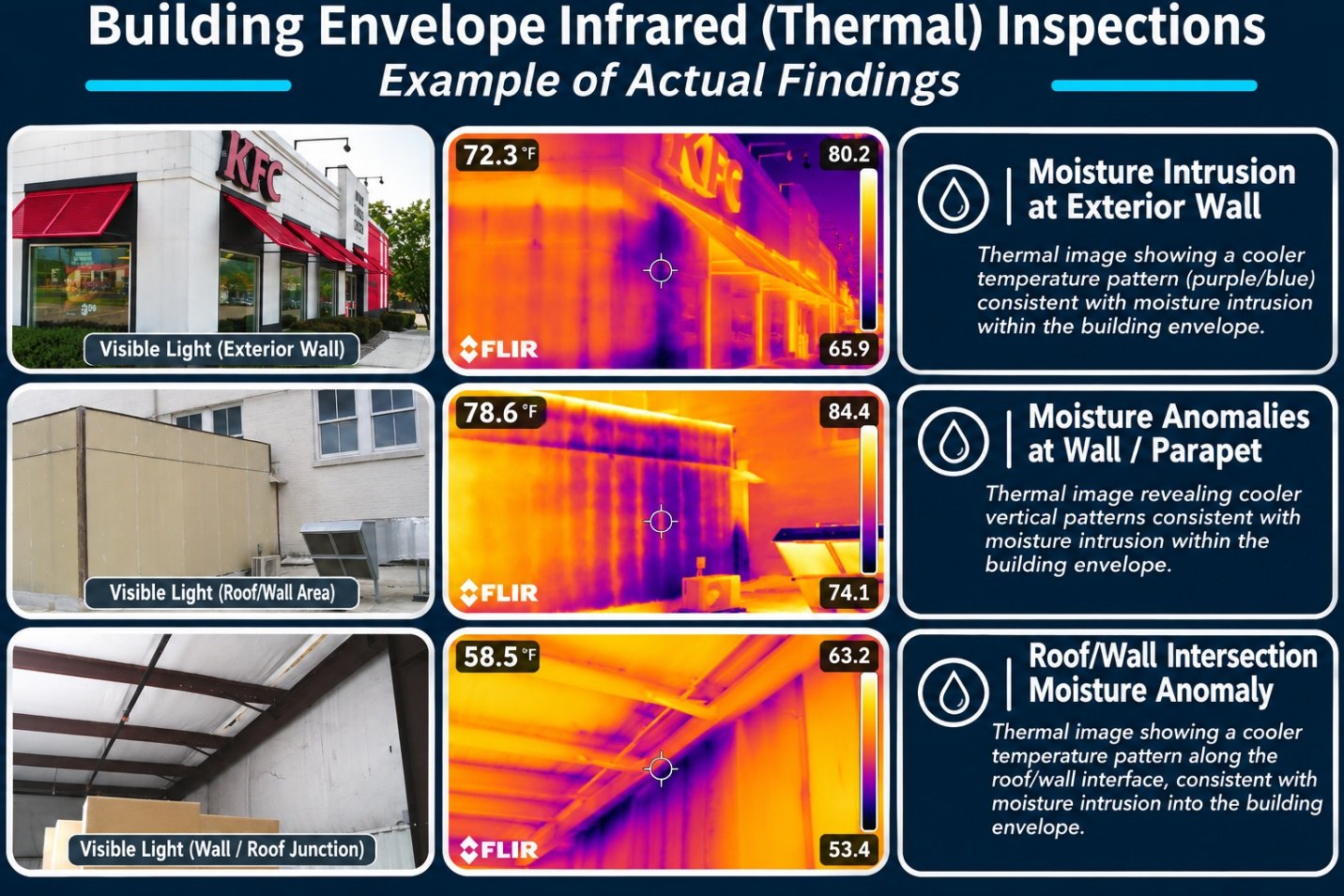
Our infrared inspections are available as stand-alone services or optional add-ons to Property Condition Assessments (PCAs), Commercial Building Inspections, and Facility Condition Assessments (FCAs).
What Is a Building Envelope Infrared Inspection?
A building envelope infrared inspection uses thermal imaging technology to evaluate temperature patterns across accessible building surfaces.
The building envelope generally includes:
- Exterior walls and cladding
- Roof and ceiling assemblies
- Windows and exterior doors
- Insulation systems
- Exterior wall penetrations
- Joints and connections between building materials
- Other components separating conditioned and unconditioned spaces
Infrared thermography can help identify areas where temperature patterns differ from surrounding surfaces.
These irregularities may indicate conditions requiring additional evaluation.
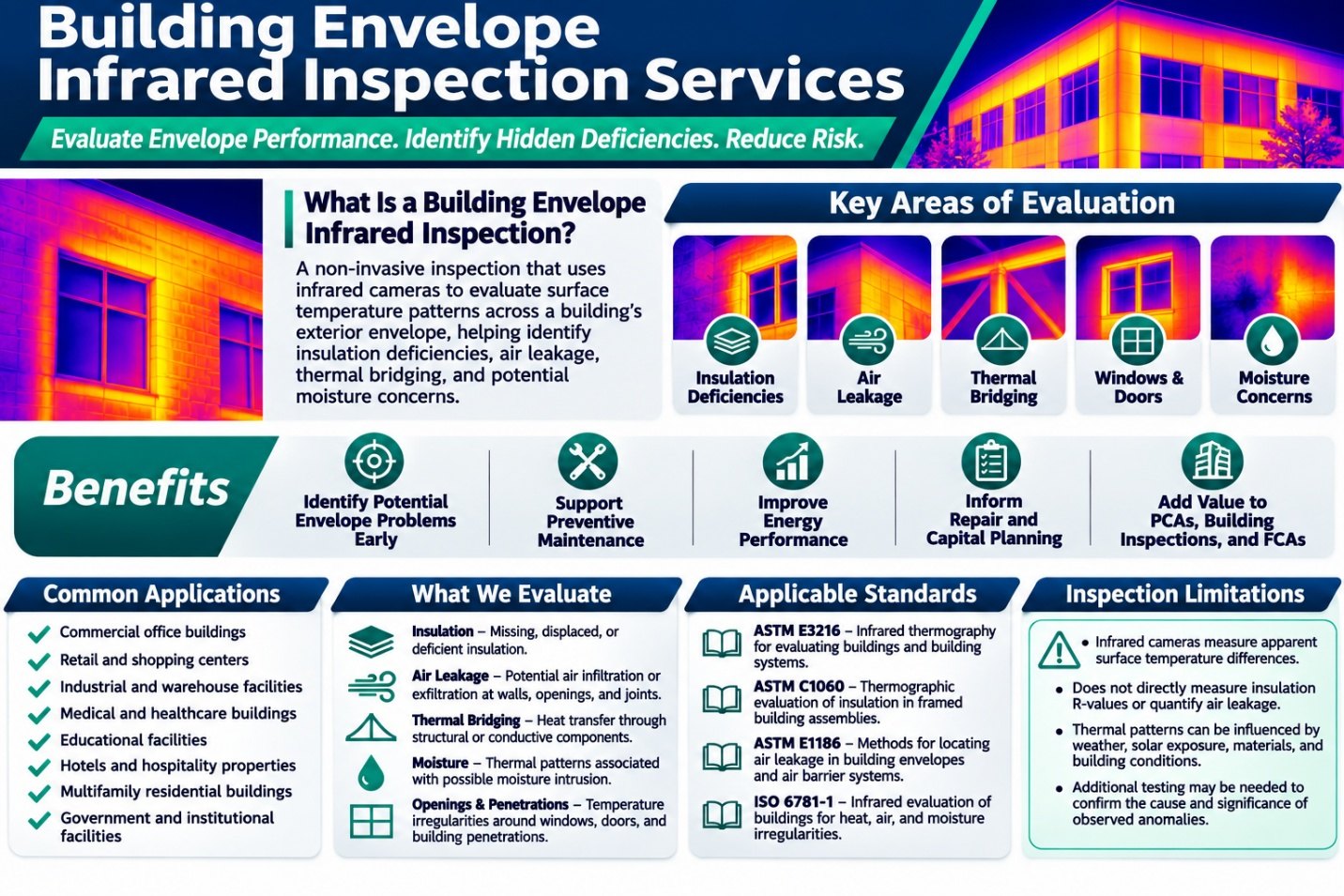
What Can Building Envelope Thermal Imaging Identify?
Missing or Deficient Insulation
Insulation helps control heat transfer through building assemblies.
Infrared imaging may reveal unusual temperature patterns associated with missing, displaced, compressed, or improperly installed insulation.
The effectiveness of the evaluation depends on the building assembly, temperature differences, and environmental conditions.
Thermal Bridging
Thermal bridging occurs when heat transfers through building materials that provide a more conductive path between interior and exterior conditions.
Examples may include structural framing, metal components, and certain connections within building assemblies.
Thermal imaging may help identify thermal patterns associated with these conditions.
Suspected Air Leakage
Uncontrolled air movement through exterior walls, windows, doors, and building penetrations can affect comfort and energy performance.
Under suitable conditions, infrared imaging may help locate temperature irregularities associated with air infiltration or exfiltration.
Additional pressure testing or other diagnostic procedures may be needed to confirm air leakage.
Moisture-Related Thermal Anomalies
Moisture intrusion can affect exterior walls, ceilings, and other building envelope components.
Infrared imaging may help identify temperature differences associated with suspected moisture, although additional testing is necessary to confirm moisture content.
Windows, Doors, and Exterior Openings
Thermal imaging may help identify unusual temperature patterns around:
- Window frames
- Exterior doors
- Glazing connections
- Perimeter sealants
- Wall openings
- Building envelope penetrations
These observations can help identify locations that may warrant additional investigation.
Why Are Building Envelope Inspections Important?
Building envelope deficiencies can contribute to moisture damage, energy loss, interior comfort problems, and premature deterioration of building materials.
An infrared building envelope inspection may help:
- Identify potential insulation deficiencies
- Locate suspected air leakage paths
- Evaluate unusual thermal patterns
- Support building maintenance planning
- Identify locations requiring additional moisture investigation
- Document thermal conditions for future comparison
- Support commercial property due diligence
Thermal imaging is a diagnostic tool and does not independently establish a building's energy efficiency or compliance with applicable building codes.
Our Building Envelope Inspection Process
Step 1 — Review the Property
We discuss the building's construction, known concerns, previous repairs, and inspection objectives.
Step 2 — Evaluate Environmental Conditions
Indoor and outdoor temperatures, weather, solar exposure, wind, and building pressure conditions may affect infrared imaging results.
Step 3 — Conduct the Infrared Survey
Accessible building envelope surfaces are evaluated for unusual thermal patterns.
Step 4 — Document Observations
Relevant thermal anomalies are documented with infrared images, visible-light photographs, and supporting observations.
Step 5 — Prepare the Report
The report describes the observed conditions, inspection limitations, and recommendations for further evaluation when appropriate.
Building Envelope Infrared Inspection Standards
Depending on the project scope, relevant standards may include:
ASTM E3216
General guidance for infrared evaluation of buildings and building systems.
ASTM C1060
Thermographic evaluation of insulation installations in framed building envelope cavities.
ASTM E1186
Methods for locating air leakage in building envelopes and air barrier systems.
ISO 6781-1
Infrared procedures for evaluating heat, air, and moisture irregularities in buildings.
The applicable standard depends on the construction type, inspection conditions, and objectives.
Certified Infrared Thermography Professionals
Our services are supported by Level I Infrared Thermography Certification from the Infraspection Institute, with access to affiliated Level III thermography consulting expertise certified through ITC/FLIR.
Important Limitations
Infrared cameras measure apparent surface temperature differences and do not directly measure insulation R-values, air leakage rates, or overall building energy consumption.
Thermal patterns may be influenced by structural materials, reflective surfaces, solar exposure, HVAC operation, and environmental conditions.
Additional testing may be needed to confirm the cause and significance of identified anomalies.
Frequently Asked Questions
Can infrared imaging find missing insulation?
Under suitable conditions, infrared thermography may identify thermal patterns associated with missing or deficient insulation.
Can thermal imaging detect air leaks?
Thermal imaging may help locate temperature patterns associated with air movement, but it does not directly measure airflow or building airtightness.
Can infrared inspections help improve energy efficiency?
They may help identify areas requiring further investigation for insulation or air leakage concerns. Actual energy savings require additional analysis.
When is the best time for a building envelope infrared inspection?
Appropriate indoor-to-outdoor temperature differences and stable environmental conditions are often important. Scheduling depends on the inspection objectives.
Can infrared inspections be performed on older commercial buildings?
Yes. Both older and newer commercial buildings may benefit from infrared building envelope evaluations.